Discover the importance of a power of attorney for aging parent care. Secure peace of mind with this essential 2026 guide for families.

TL;DR:
A power of attorney for an aging parent is a legal document that grants a trusted person, called an agent, the authority to make financial, medical, or personal decisions on the parent's behalf. Without it, families face a legal wall at the worst possible moment. Getting this document in place while your parent is healthy and clear-minded is one of the most practical things you can do right now.
The four types of power of attorney most relevant to elder care are the durable financial POA, the healthcare power of attorney (also called medical POA), the springing POA, and the limited POA. Each one serves a different purpose, and understanding the differences protects your family from gaps in coverage.
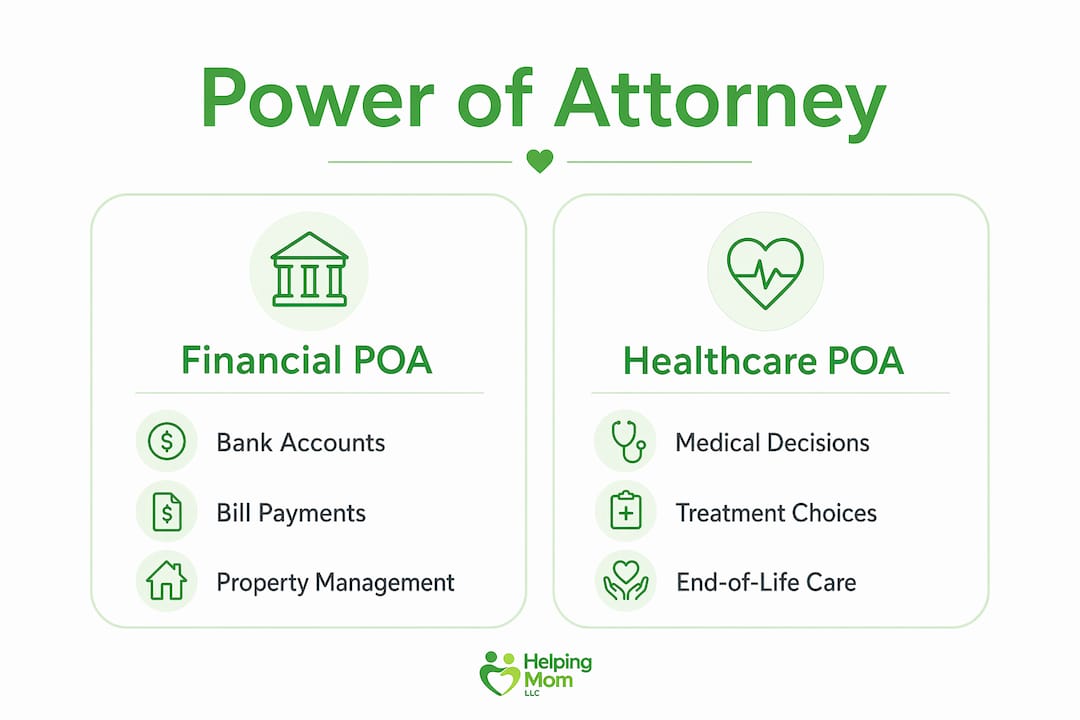
A durable financial POA gives your agent authority over bank accounts, bill payments, investments, and property. The word "durable" is the critical piece. A general POA usually ends the moment your parent loses mental capacity, which is exactly when you need it most. A durable POA includes explicit language that keeps the agent's authority intact through incapacity.
A healthcare power of attorney (or medical POA) allows your agent to make real-time medical decisions that reflect your parent's values when they cannot speak for themselves. Medical POA prevents family conflict by clearly designating one decision-maker during a health crisis. This is especially important when siblings disagree on treatment options.
A springing POA only activates when a specific condition is met, usually a physician's declaration of incapacity. A limited POA covers a single transaction or time period, such as selling a property while your parent is traveling.
Here is a quick comparison to help you choose:
| POA Type | Scope | When It Activates | Survives Incapacity? |
|---|---|---|---|
| Durable Financial | Bank accounts, bills, property | Immediately upon signing | Yes |
| Healthcare (Medical) | Medical decisions | When parent cannot decide | Yes |
| Springing | Financial or medical | Upon declared incapacity | Yes |
| Limited | Single transaction | Immediately, for set purpose | No |
Note that 31 states and Washington D.C. have adopted the Uniform Power of Attorney Act, which presumes POAs are durable unless stated otherwise. In the remaining states, you must include explicit durability language or the document expires at incapacity.
Pro Tip: Combine a durable financial POA with a healthcare POA. These two documents cover different territory and work together. One without the other leaves real gaps in your parent's protection.
Mental capacity is the legal requirement that your parent understands who they are appointing, what authority they are granting, and what the consequences are. A POA cannot be established if your parent lacks this capacity at the time of signing. There is no legal workaround.

This is where many families wait too long. Conditions like Alzheimer's disease and other forms of dementia do not follow a straight line. Capacity can fluctuate day to day, with a phenomenon called sundowning causing confusion in the late afternoon and evening even in people who are clear-minded in the morning. A parent who seems fine at breakfast may not legally qualify to sign documents by dinnertime.
Common signs that capacity may be slipping include:
If your parent is in the early stages of a progressive illness, act now. Waiting too long forces families into court-supervised guardianship, which can cost $1,500 to over $10,000 upfront, plus months of delay and ongoing legal oversight. That is a painful and expensive outcome that a timely POA prevents entirely.
Pro Tip: Ask your parent's primary care physician to document their mental capacity at the time of signing. A brief written note in the medical record can prevent legal challenges later, especially if siblings or other parties question the document's validity.
The process is more straightforward than most people expect. Here is a clear path forward:
The most important legal and emergency documents are only useful if someone can find them when they're needed.
The Helping Mom Calm Care Essentials Bundle gives you a simple place to keep:
Even when you know what to do, the path is not always smooth. These are the most common obstacles families face, and practical ways through them.
Your parent refuses. This is more common than people expect. Parental refusal can sometimes be overcome by involving a trusted third party, such as a family friend, a clergy member, or a family doctor who can explain the practical reasons. Gentle persistence over time often works better than a single direct conversation. Respect your parent's pace while staying consistent.
Siblings disagree. Conflict between adult children over who should serve as agent is one of the most common sources of family tension in elder care. A family meeting with a clear agenda helps. If disagreements run deep, a mediator or elder law attorney can facilitate a productive conversation before the document is signed.
Concerns about undue influence. If one family member is pressuring your parent to name them as agent, that is a serious legal and ethical problem. Signs of undue influence include your parent suddenly changing their preferences, seeming fearful, or being isolated from other family members. An attorney can help assess whether the signing is truly voluntary.
Guardianship as a last resort. If your parent has already lost capacity and no POA exists, guardianship or conservatorship through the courts becomes the only option. Guardianship proceedings involve court filing fees, guardian ad litem costs, bond premiums, and ongoing court reporting. The financial and emotional cost is significant. Early planning is the only way to avoid it.
Holding a POA is a real responsibility. The agent's job is to act in the parent's best interests, not their own. Proper use of POA requires understanding the scope of authority, keeping detailed records, and communicating openly with family members.
A financial POA does not give you unlimited access to your parent's assets. You cannot use their funds for personal benefit, make gifts on their behalf without explicit permission in the document, or change their will. Healthcare POA authority is similarly bounded by your parent's previously stated wishes and the document's specific language.
Document every financial transaction you make as an agent. Keep receipts, bank statements, and notes about decisions made. Share updates with siblings and other family members regularly. Transparency prevents conflict and protects you legally if questions arise later.
Bring copies of the POA to every relevant institution. Healthcare providers need the medical POA on file before a crisis occurs. Financial institutions need the financial POA registered before you need to act. Doing this in advance removes friction at the moments that matter most. For guidance on managing finances for parents, Helping-mom has a practical resource that walks through the key steps.
Establishing a durable power of attorney for an aging parent is the single most important legal step families can take before a health crisis occurs, and it must be done while the parent still has mental capacity.
| Point | Details |
|---|---|
| Act before capacity is lost | POA cannot be signed after incapacity; waiting forces costly guardianship proceedings. |
| Use durable POA documents | A general POA expires at incapacity; durable language keeps the agent's authority intact. |
| Combine financial and medical POA | These two documents cover different decisions and work together for full protection. |
| Document capacity at signing | A physician's note at signing prevents future legal challenges from family members. |
| Register POA with all institutions | Deliver copies to banks and healthcare providers before a crisis, not during one. |
I've talked with a lot of families who waited. Not because they didn't care, but because the conversation felt too heavy to start. They thought there was more time. Then a fall happened, or a diagnosis came, and suddenly the window had closed.
The thing most people don't realize is that setting up a power of attorney is not about preparing for the worst. It is about honoring your parent's right to choose who speaks for them. When you frame it that way, the conversation changes. Your parent is not giving up control. They are exercising it.
Choosing the right agent matters more than most families realize. I've seen situations where the most organized, level-headed sibling was passed over because they lived out of state, and the local sibling who was chosen struggled with the responsibility. Proximity is not the same as capability. Choose the person who will stay calm, keep records, and put your parent's wishes first, even when it's hard.
One more thing: don't let perfect be the enemy of good. A simple durable POA completed today is worth far more than a comprehensive plan that never gets finished. Start with what you can do this week. The caring for aging parents checklist at Helping-mom is a good place to begin if you're not sure where to start.
— Mike
Legal planning is just one part of caring for an aging parent. Once the documents are in place, the day-to-day work of keeping your parent safe and comfortable at home begins. Helping-mom offers practical, calm guidance for every stage of that process. Start with the home safety guide for seniors to identify and address risks in your parent's home before they become problems. For a broader view of what elder care planning involves, the elder care planning guide walks you through the key decisions in a clear, manageable way. You don't have to figure this out alone.
A comprehensive guide to legal authority, budgeting, fraud protection, and cost-saving programs.
Navigate elder care with confidence — assess needs, gather vital documents, and protect your parent's choices.
A practical guide to organizing calm, productive family conversations about aging parent care.
Explore our comprehensive guides to help you navigate legal planning, home safety, and caregiving with confidence and compassion.