Discover the important papers aging parents need to ensure smooth legal, financial, and medical decisions. Protect your family today!

TL;DR:
- Gathering essential legal and medical documents helps families avoid court issues and family conflicts during emergencies. Regularly reviewing and updating these papers ensures they reflect current wishes, health, and legal standards. Organized, accessible files and consistent conversations protect aging parents' autonomy and minimize family stress.
Gathering the important papers aging parents need is one of the most practical acts of care you can offer. These documents, collectively called an advance care planning file or elder care legal file, cover three areas: legal authority, financial management, and medical decision-making. Without them, families often face court-ordered guardianships, frozen bank accounts, and painful disagreements at the worst possible moments. The good news is that assembling these papers is straightforward when you know what to collect, where to store it, and when to update it.
I know this conversation can feel uncomfortable. Most of us don't wake up one morning excited to talk with our parents about wills, medical decisions, or powers of attorney. But I've learned that these conversations are almost always easier before there is a crisis. A little preparation today can spare your family an incredible amount of stress later.
If you're just beginning to organize your parent's care, you don't have to figure everything out alone. Download the Helping Mom Caregiver Starter Kit — a free collection of practical checklists and planning tools designed to help you stay organized and reduce stress.
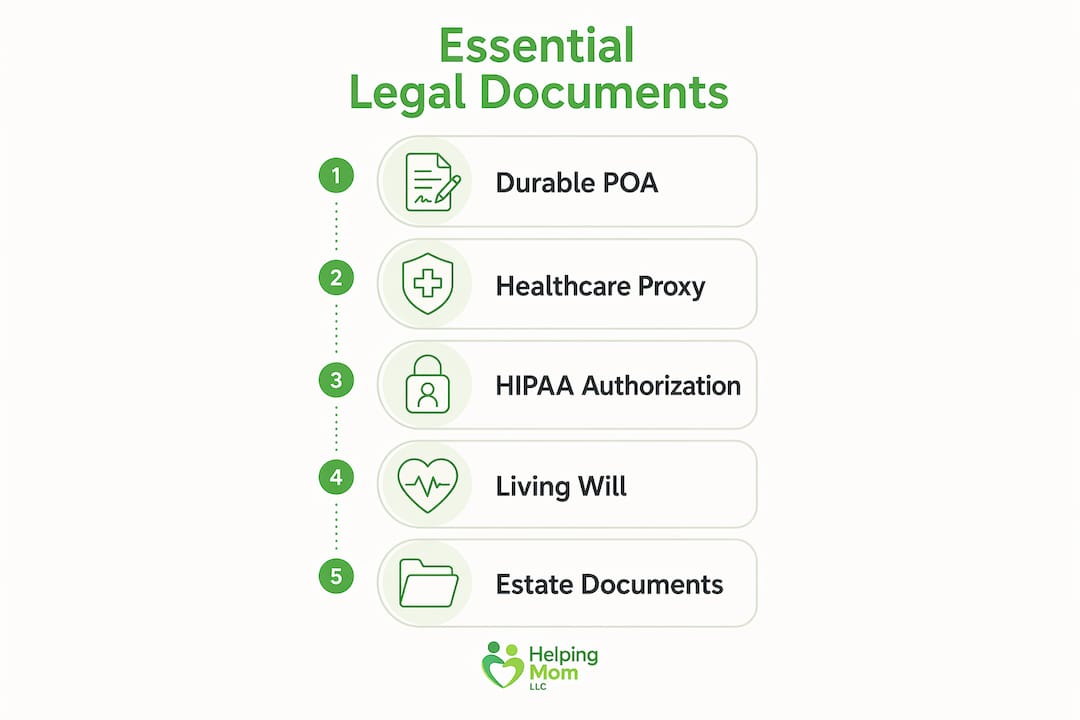
Get your free Caregiver Starter Kit hereFor most families, the five core legal documents include a Durable Financial Power of Attorney, a Healthcare Proxy, a HIPAA Authorization, a Living Will, and a Will or Revocable Living Trust. These five documents cover financial, medical, and estate matters and prevent court intervention when a parent can no longer speak for themselves. Each one serves a distinct purpose, and missing even one can create serious gaps.
A Durable Financial Power of Attorney (DPOA) authorizes a named person, called the agent, to manage a parent's bank accounts, pay bills, file taxes, and handle property. "Durable" means the authority stays in place even if the parent becomes incapacitated. One important detail: some DPOAs are "springing," meaning they require physician certification of incapacity before the agent can act. That certification process can take days, which is a real problem in a medical emergency. An immediately effective DPOA avoids that delay, though it requires trust between parent and agent.

A Healthcare Proxy, also called a Medical Power of Attorney, appoints someone to make medical decisions when a parent cannot. Without one, family members may be excluded from care discussions entirely, even if they are the primary caregiver. A HIPAA Authorization is a separate but equally important form. It gives named family members legal permission to receive medical information from doctors, hospitals, and insurers. These two documents work together and should both be signed at the same time.
A Living Will, sometimes called an Advance Directive, records a parent's specific wishes about end-of-life care, such as whether they want resuscitation, ventilator support, or feeding tubes. It guides doctors and relieves family members from making those decisions alone under pressure. A Will governs how assets are distributed after death. A Revocable Living Trust goes further: a properly funded trust allows a successor trustee to manage assets without any court involvement, which saves time and legal fees during incapacity or after death.
Pro Tip: Legal documents must meet your state's specific witness and notarization requirements. Informal or downloaded forms that skip these steps risk being declared invalid, which can trigger a costly court guardianship.
Having both a Financial Power of Attorney and a separate Healthcare Power of Attorney matters because they govern different decisions. One person can hold both roles, or you can name different people based on their strengths and availability.
A centralized "life file" is the single most practical tool a caregiver can build. Creating a life file with all financial accounts, insurance policies, medication lists, and healthcare provider contacts reduces stress during emergencies and speeds up decision-making. Think of it as a single source of truth that anyone trusted can access when time is short.
Here is how to build one step by step:
A well-organized caregiver binder makes all of this easier. Consider using our Emergency Contact List template to keep key contacts in one place, and our Medication Tracker to prevent missed doses. If you're building a complete medical information organizer, include a Family Meeting Agenda to keep everyone aligned during family caregiver planning discussions.
Pro Tip: Avoid storing original legal documents in a bank safe deposit box. If your parent becomes incapacitated, inaccessible document storage can block urgent decisions until a court grants access, which defeats the purpose of having the documents in the first place.
Legal documents establish authority. Financial and medical records give that authority real substance. Without the account numbers, policy details, and medication lists, even a named agent can spend weeks tracking down information during a crisis.
The financial records to gather include:
The medical records to gather include:
| Record Type | What to Include |
|---|---|
| Bank accounts | Account numbers, institution names, branch phone numbers |
| Insurance policies | Policy numbers, insurer contacts, premium due dates |
| Medicare and Social Security | Plan numbers, benefit amounts, enrollment dates |
| Medications | Drug names, dosages, prescribing doctors |
| Medical history | Diagnoses, allergies, surgeries, specialist contacts |
Estate planning is not reserved for wealthy families. It is a practical tool for Medicaid eligibility and protecting assets from long-term care costs. Planning asset transfers early, before a care need arises, keeps options open and avoids state-imposed penalty periods.
As you organize your aging parent paperwork, you may also find it helpful to keep a family meeting guide on hand, or use our home safety checklist to address environmental risks alongside your document planning. For tracking cognitive changes over time, our memory changes tracker can help you prepare more effectively for doctor visits.
Documents signed ten years ago may no longer reflect your parent's wishes, health situation, or state law. Review all documents every 2 to 3 years or after any major life event. That review schedule keeps everything current and legally sound.
Specific triggers that call for an immediate review include:
Reviewing named agents to confirm they are still willing and able to serve is one of the most overlooked steps. An agent who has moved across the country, developed health problems, or grown distant from the family may not be the right person anymore. Naming a successor agent in the original document avoids a gap in authority if the primary agent cannot serve.
An elder law attorney can flag whether existing documents still meet current state requirements. Laws around advance directives and powers of attorney do change, and a document that was valid a decade ago may need updating. Scheduling a brief annual check-in with an attorney costs far less than a guardianship proceeding.
Organizing the legal, financial, and medical paperwork for an aging parent is the single most effective way to protect their wishes and reduce family stress during a crisis.
| Point | Details |
|---|---|
| Five core legal documents | Secure a DPOA, Healthcare Proxy, HIPAA Authorization, Living Will, and Will or Trust. |
| Build a centralized life file | Combine legal, financial, and medical records in one accessible, fireproof location. |
| Review every 2 to 3 years | Update documents after major life events or changes in health, location, or family. |
| Check named agents regularly | Confirm agents are still willing, capable, and reachable before a crisis occurs. |
| Estate planning protects everyone | Early Medicaid and asset planning preserves options and avoids costly delays. |
I've seen what happens when families skip this step. A parent has a stroke on a Tuesday, and by Wednesday the adult children are calling banks, hospitals, and attorneys, none of whom can share a single piece of information without legal authority. The documents existed, but they were in a safe deposit box no one could open. That situation is more common than most people realize.
The conversations that lead to these documents being signed are genuinely hard. Many older adults avoid advance care planning because it feels like rehearsing for loss. The most effective approach is not a single formal sit-down. It is a series of calm, low-stakes conversations over time. You might start by asking your parent what matters most to them about their care, not what paperwork they have signed. That question opens a door without pressure.
One thing families often get wrong is treating this as a one-time task. They gather the documents, file them away, and never look again. Then a named agent moves to another state, or a parent's wishes shift after a new diagnosis, and no one updates anything. The documents become a false sense of security. A living file, reviewed regularly, is what actually protects a family.
If you are not sure how to start the conversation with your parent, Helping-mom has a practical guide on talking with aging parents about care that walks you through it without making it feel like a legal intervention. And if you are thinking about end-of-life preparation more broadly, resources like funeral pre-planning can help families address those wishes before a crisis forces the conversation.
You don't have to complete everything this weekend. Start with one folder. Gather one document. Have one conversation. Small steps taken today often become the reason a future crisis feels manageable instead of overwhelming.
— Mike C.
If this article helped you start thinking about organizing important documents, you may also find these resources helpful:
All of these resources are free and written in plain language, without clinical jargon.
A comprehensive framework for managing health, legal, and family conversations together.
Legal authority, budgeting, fraud protection, and cost-saving programs explained.
Compassionate conversation guides for discussing safety, independence, and care decisions.
Explore our comprehensive guides to help you navigate legal, financial, and care planning with confidence and compassion.
This article was published on July 7, 2026 by Helping Mom LLC. It is part of our ongoing series helping adult children navigate the legal, financial, and medical decisions that come with caring for aging parents. Our goal is to provide practical, compassionate guidance in plain language — without clinical jargon.